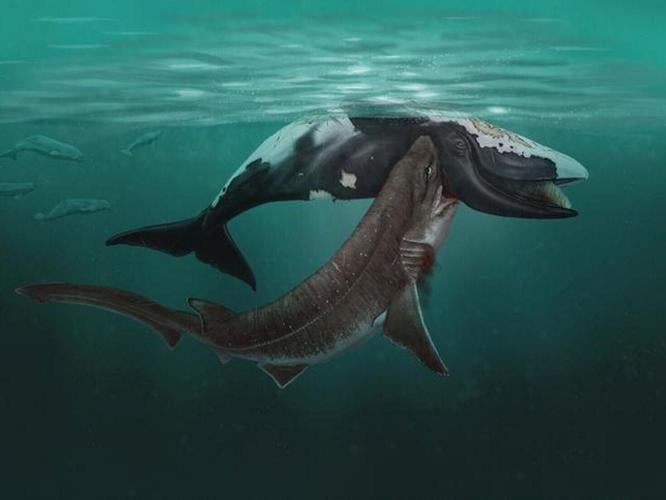
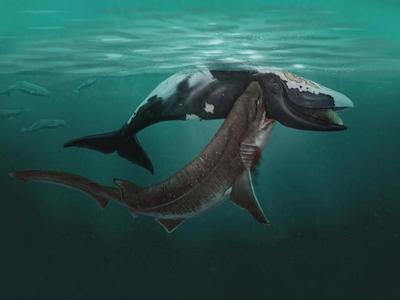
A painted reconstruction of a bluntnose six-gill shark (or cow shark) scavenging on a tiny extinct right whale carcass during the Early Pliocene of the southern North Sea. A pod of an extinct whale related to today's belugas swimming in the background. (Alexander Lovegrove via SWNS)
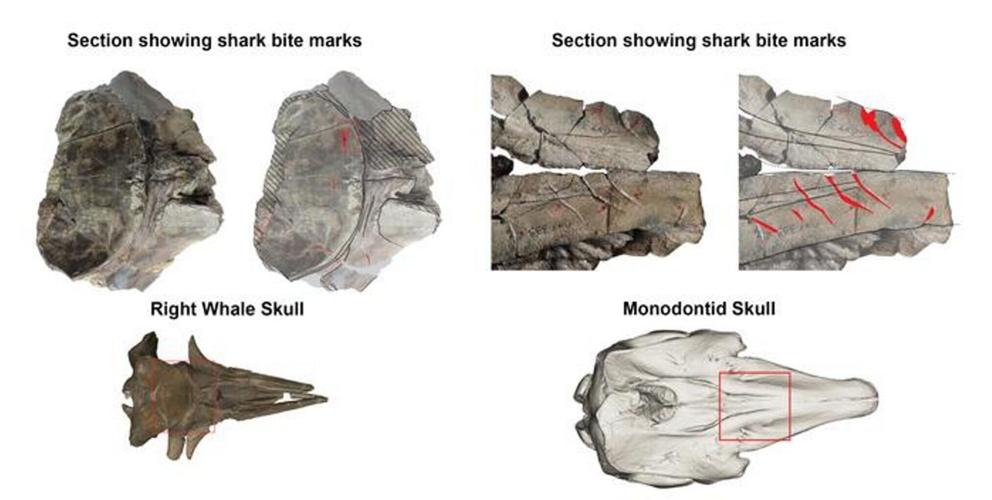
Photographs (left) showing the extinct right whale partial skull with shark bite marks highlighted in red. The more complete skull on the lower part of the illustration is from another individual of the same right whale species. Photographs (right) showing shark bite marks on the rostrum of the monodontid cranium, targeting the fat-rich melon. The skull on the lower part of the illustration is the one of a modern beluga. (Olivier Lambert via SWNS)
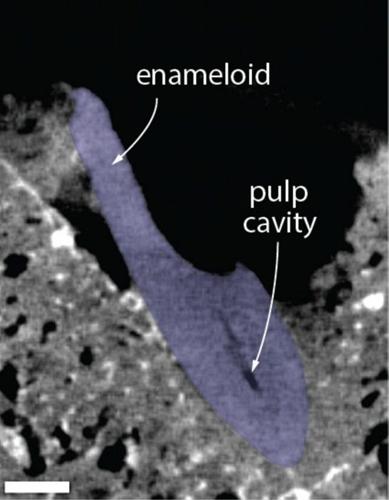
CT scan view of the tip of bluntnose six-gill shark (or cow shark) tooth (blue) found embedded in the extinct right whale skull. Scale bar = 1 mm). (Olivier Lambert via SWNS)
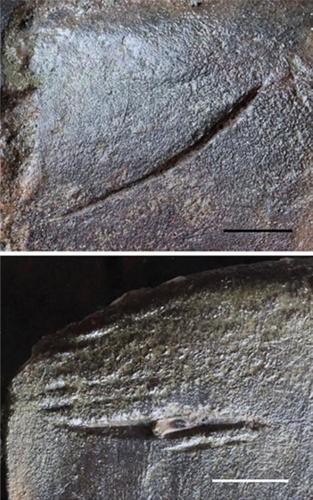
Photo detail of some shark bite marks on the skull of the extinct right whale. The lower photo shows a bite made by the bluntnose six-gill shark, with a tooth tip deeply embedded in the bone. Scale bars = 10 mm. (Olivier Lambert via SWNS)
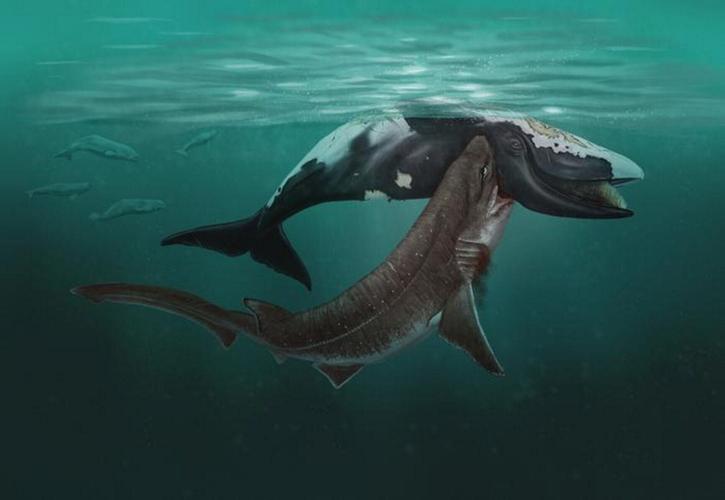
A painted reconstruction of a bluntnose six-gill shark (or cow shark) scavenging on a tiny extinct right whale carcass during the Early Pliocene of the southern North Sea. A pod of an extinct whale related to today's belugas swimming in the background. (Alexander Lovegrove via SWNS)
By Stephen Beech
Great white sharks' ancestors were attacking and eating whales in the North Sea five million years ago, reveals new research.
Photographs (left) showing the extinct right whale partial skull with shark bite marks highlighted in red. The more complete skull on the lower part of the illustration is from another individual of the same right whale species. Photographs (right) showing shark bite marks on the rostrum of the monodontid cranium, targeting the fat-rich melon. The skull on the lower part of the illustration is the one of a modern beluga. (Olivier Lambert via SWNS)
CT scan view of the tip of bluntnose six-gill shark (or cow shark) tooth (blue) found embedded in the extinct right whale skull. Scale bar = 1 mm). (Olivier Lambert via SWNS)
Photo detail of some shark bite marks on the skull of the extinct right whale. The lower photo shows a bite made by the bluntnose six-gill shark, with a tooth tip deeply embedded in the bone. Scale bars = 10 mm. (Olivier Lambert via SWNS)
Keep it Clean. Please avoid obscene, vulgar, lewd,
racist or sexually-oriented language. PLEASE TURN OFF YOUR CAPS LOCK. Don't Threaten. Threats of harming another
person will not be tolerated. Be Truthful. Don't knowingly lie about anyone
or anything. Be Nice. No racism, sexism or any sort of -ism
that is degrading to another person. Be Proactive. Use the 'Report' link on
each comment to let us know of abusive posts. Share with Us. We'd love to hear eyewitness
accounts, the history behind an article.







(0) comments
Welcome to the discussion.
Log In
Keep it Clean. Please avoid obscene, vulgar, lewd, racist or sexually-oriented language.
PLEASE TURN OFF YOUR CAPS LOCK.
Don't Threaten. Threats of harming another person will not be tolerated.
Be Truthful. Don't knowingly lie about anyone or anything.
Be Nice. No racism, sexism or any sort of -ism that is degrading to another person.
Be Proactive. Use the 'Report' link on each comment to let us know of abusive posts.
Share with Us. We'd love to hear eyewitness accounts, the history behind an article.