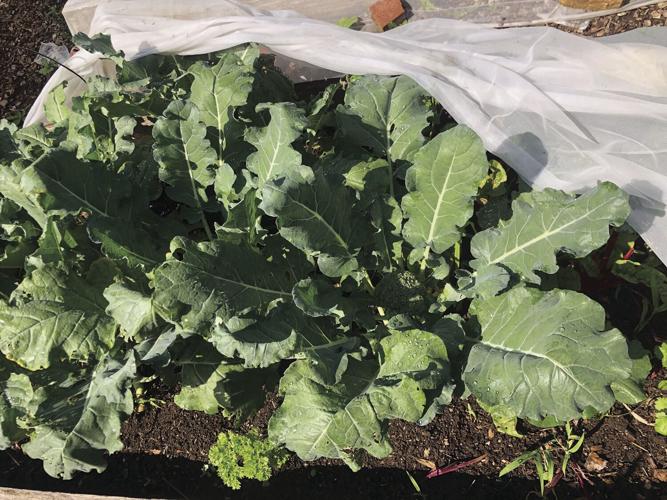
Tomatoes and peppers are struggling, but cool weather cultivars — lettuce, broccoli, cabbage — under protective mesh row covers are moving toward maturity. (ANN BENNETT PHOTO)
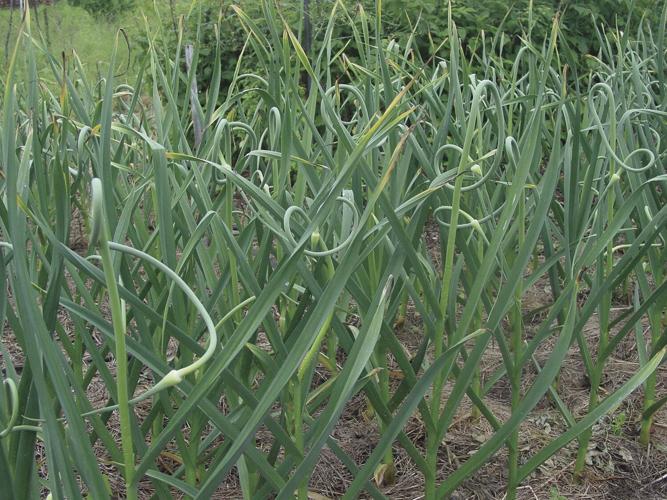
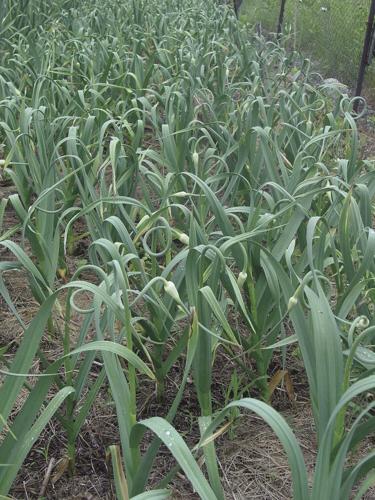
The garlic crop has thrived despite the deluge, and in the past week has sent up “scapes,” the flower stalks of hardneck varieties. These stalks start to appear a month or so before the crop is ready for harvest, and need to be cut from the plant, since leaving them on only diverts energy away from bulb development. (ANN BENNETT PHOTO)
The garlic crop has thrived despite the deluge, and in the past week has sent up “scapes,” the flower stalks of hardneck varieties. These stalks start to appear a month or so before the crop is ready for harvest, and need to be cut from the plant, since leaving them on only diverts energy away from bulb development. (ANN BENNETT PHOTO)
Tomatoes and peppers are struggling, but cool weather cultivars — lettuce, broccoli, cabbage — under protective mesh row covers are moving toward maturity. (ANN BENNETT PHOTO)
Tomatoes and peppers are struggling, but cool weather cultivars — lettuce, broccoli, cabbage — under protective mesh row covers are moving toward maturity. (ANN BENNETT PHOTO)
The garlic crop has thrived despite the deluge, and in the past week has sent up “scapes,” the flower stalks of hardneck varieties. These stalks start to appear a month or so before the crop is ready for harvest, and need to be cut from the plant, since leaving them on only diverts energy away from bulb development. (ANN BENNETT PHOTO)
The garlic crop has thrived despite the deluge, and in the past week has sent up “scapes,” the flower stalks of hardneck varieties. These stalks start to appear a month or so before the crop is ready for harvest, and need to be cut from the plant, since leaving them on only diverts energy away from bulb development. (ANN BENNETT PHOTO)
Tomatoes and peppers are struggling, but cool weather cultivars — lettuce, broccoli, cabbage — under protective mesh row covers are moving toward maturity. (ANN BENNETT PHOTO)
July’s full Buck Moon was a bit of a bust on the 3rd, obscured by low clouds and showers. It did peek through in the wee hours of morning on July 1, briefly bathing the night sky in moonlight. July’s was the first of four supermoons in 2023, a celestial occurrence when the full moon coincides with the moon's closest approach to Earth in its orbit. Supermoons appear a little brighter and closer than normal, although the difference of 6.9 percent is hard to spot with the naked eye.
The opportunity to appreciate this phenomenon comes around again on Aug. 1 with the full Sturgeon Moon, referred to by some as the Green Corn Moon. The month delivers a second Blue Moon on the 30th. September’s Harvest Moon is the fourth and 2023’s final supermoon on the 29th.
Keep it Clean. Please avoid obscene, vulgar, lewd,
racist or sexually-oriented language. PLEASE TURN OFF YOUR CAPS LOCK. Don't Threaten. Threats of harming another
person will not be tolerated. Be Truthful. Don't knowingly lie about anyone
or anything. Be Nice. No racism, sexism or any sort of -ism
that is degrading to another person. Be Proactive. Use the 'Report' link on
each comment to let us know of abusive posts. Share with Us. We'd love to hear eyewitness
accounts, the history behind an article.








(0) comments
Welcome to the discussion.
Log In
Keep it Clean. Please avoid obscene, vulgar, lewd, racist or sexually-oriented language.
PLEASE TURN OFF YOUR CAPS LOCK.
Don't Threaten. Threats of harming another person will not be tolerated.
Be Truthful. Don't knowingly lie about anyone or anything.
Be Nice. No racism, sexism or any sort of -ism that is degrading to another person.
Be Proactive. Use the 'Report' link on each comment to let us know of abusive posts.
Share with Us. We'd love to hear eyewitness accounts, the history behind an article.