




The story of Mount Washington's summit buildings has been well told, as has the huts of the Appalachian Mountain Club, which in 1988 celebrated the 100th anniversary of its hut system.
Other structures were designed to serve the coaching tourism business of the 19th century. Among those was the Chocorua Peak House, built in 1891 by some accounts or 1884, according to others.
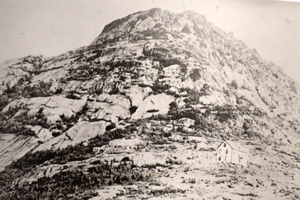
The Peak House served visitors to 3,475-foot Mount Chocorua. But its tradition of offering great meals and comfortable lodgings came to end Sept. 26, 1915, during a tremendous gale.
When the skies cleared, Mrs. Ina Morrill of Iona Village in Albany was the first to discover that the three-story guest house had been blown off the mountain.
Hanging up her wash, Ina gazed toward Chocorua to enjoy the view that morning and realized the house was gone. Hearing his wife shout the news, Louis Morrill at first didn't believe his ears until he, too, ran outside.
The Morrills, having seen flickering lights the night before, worried that the owners, David Knowles and his family, had lost their lives in the disaster.
According to an account published in 1977 in "Albany's Recollections," Louis ran down to the Clement Inn, and soon he and Morris Clement were on their way up the Piper Trail to the summit, fearing the worst.
"As the men neared the top," editor A. Bernard Perry noted, "they began to see bits of destruction. A set of stairs leaned against an oak tree in an upright position; beneath the stairs was cutlery, just as if someone had placed it there very carefully. Further along, the timbers were scattered everywhere."
Upon reaching the site of the house, Morrill found the broken guide chains that had been keeping the dwelling in place, still fastened securely to the mountain ledge.
Later, Morrill and Clement learned Knowles had hiked to the Peak House the day before the gale but had returned to his home in Silver Lake by lantern light, thus explaining the lights seen on the summit.
No lives were lost, but the storm symbolized the end of an era of mountaintop hospitality.
That era got its start when colorful mountain man Jim "Dutch" Liberty built a road on Chocorua for which he obtained a charter from the state of New Hampshire.
A Tamworth resident of French-Canadian descent, Liberty was known as "Dutch" because of his poor English.
The Liberty Road started from the Charles Durrell house in Tamworth and went to an old logging camp in Albany, according to Marion Nickerson and John A. Down's 1977 book, "Chocorua Peak House." Liberty constructed the Halfway House and stable and improved the path to the summit.
"Jim Liberty was always working with stone," Nickerson noted.
Near the top of the mountain, Liberty built a camp of split stone, just under the area known as Chocorua's Cone. When the canvas roof blew off soon after, and the wood purchased for a roof burned in a sawmill fire, Nickerson said Liberty pitched two tents inside the rock walls. Outside, he set up a cookstove.
"He would puff on his old clay pipe," Nickerson wrote, "while his strong green tea brewed over the open fire. (He would play) his accordion and sing French songs. He was at home on the mountain," she added, "and his name has been associated with Chocorua ever since."
Liberty later sold his Chocorua Mountain Road and Halfway House to Knowles. Knowles had envisioned building a summit hotel after hiking the mountain on a clear day. From Chocorua, he could see Mount Washington's Summit House to the distant north and being an enterprising young man, dreamed of owning a similar building on Chocorua.
"Young David was a very versatile man — builder, florist and musician who taught singing classes in several towns," Nickerson wrote.
A Chocorua Village resident, Nickerson wanted to preserve stories she'd heard late husband, Norman Nickerson, tell of his summer with his mother and sister there in 1914.
"Norman's mother, Emma Nickerson, ran the Peak House a year before it was blown off the mountain, and Norman and his sister, Sarah, helped her with the chores," Nickerson noted in 1988. "A lot of stories have it that they were all up there the summer of the storm, but that's not correct."
Nickerson wrote that building a three-story house just under the cone of the mountain was a tremendous undertaking. "Everything had to be brought up from the base on horseback, oxen or manpower," she wrote. The work was not without its hazards; the ladder of one worker, Daniel Harmon, was blown in the air during construction, with him on it.
Knowles and partner, Newell Forrest, built the house near the site of Liberty's old tent camp, facing southeast, 1,890 feet below the summit. Hikers looking for the site today may reach it via the Liberty, Weetamoo or Hammond trials, said David Pratt III, former recreation ranger for the U.S. Forest Service's Saco District.
"After the Peak House blew off the mountain in 1915," Pratt said in 1988, "the Chocorua Mountain Club built a structure there in 1924, which also was destroyed by a windstorm in 1932. The Forest Service built the current 26-foot-by-14-foot Liberty Cabin in 1934, which provides overnight quarters on a first-come, first-served basis for six people."
Pratt said the Forest Service also operates a tent site on Chocorua known as Camp Penacook, reached by the Piper Trail off Route 16. "The summit of Mount Chocorua is now a restricted-use area," Pratt said, "with camping available only at the Liberty shelter and Camp Penacook."
Like the summit buildings on Mount Washington, Peak House was built to withstand mountain weather. Cables secured the building to the granite, and turnbuckles held them tight. But when Knowles added an ell for a dining room on the back of the building, he didn't think it was necessary to use cables to hold it in place.
"The following spring," Nickerson noted, "he found his dining hall scattered all over the side of the mountain."
The source of water was a spring about 200 yards northeast of the hotel, the first floor of which had a kitchen, dining room, parlor and small room sometimes used as a bridal suite. Several bedrooms were on the second floor, with a dormitory on the third.
From the house, hikers ascended a steep path on the rocky cone with the aid of stairs and handrails. When Jim Liberty guided guests, Nickerson said "he went up barefoot so his feet would not slip on the ledges."
Knowles installed a telephone line down to his home, Gilman Brothers' Store and the Forrests', all in Silver Lake.
"Once in a bad storm, Mrs. Carruthers of Chocorua tried to phone the village store but got Mr. Knowles on the mountain instead. He phoned her order to the store, and in a short time the delivery wagon was at her house with the provisions," Nickerson related.
To ferry provisions, Knowles made use of the family's gray mare, Gypsy. "They'd put a note in her saddle bags, and she'd go alone to Gilmans' Store, where the order would be filled, and then she'd be on her way back up the mountain," Nickerson laughed.
When Knowles became too old to run the Peak House, he asked Norman Nickerson's father, Ezra, to run it in the summer of 1914. Ezra, being a farmer, said he was too busy, but his wife, Emma, assisted by Norman and Sarah, agreed to take on the housekeeping and cooking tasks.
"By the time Norman and his mother and sister got up on the mountain in 1914, Gypsy wasn't up there anymore, so Norman — who was 15 at the time — had to go down to the Halfway House almost every day to bring up supplies in a tote basket on his back," Nickerson said.
Norman, who died in 1987 at the age of 88, also carried water from the spring.
Emma's cooking was renowned. She made fantastic blueberry pies, using berries from the mountain. When Louis Morrill and Morris Clement climbed Chocorua that morning after the big windstorm in 1915, Morrill reportedly turned to Clement and said, "You know, Morris, this is the first time I have stood here and couldn't smell the aroma coming from the table full of Emma's pies!"
What was it like to spend a night at the Peak House? Charles Beals Jr., late author of "Passaconaway in the White Mountains," described a night on the cone as a beautiful, thrilling experience, noting, "The roaring wind, which fairly rocks out mountain shelter, causes the carpet to roll in waves like billows on a storm-lashed sea. We gladly respond to the supper bell, and with zest devour steak and potatoes and Mr. Knowles' far-famed hot blueberry pie. Soon darkness envelops the house. We study the lights of far-off Portland for a time, then, wearied with our climb, we retire and speedily fall asleep.
"Next morning," Beals continued, "before four o'clock the bright tints of the eastern sky prophesy the coming of a new day. Before five the gorgeous sun begins to come into view over Mount Pleasant, Maine. 'Are we on the ocean?' we ask ourselves, for all beneath us is hidden in a white impenetrable curtain of cloud, above which the mountain peaks, here and there, appear as islands on a boiling seas."
Today, hikers may experience a similar evening by camping out at the Forest Service's two facilities at Camp Penacook and at the Jim Liberty Shelter. But you'll have to bring your own blueberry pies.


(0) comments
Welcome to the discussion.
Log In
Keep it Clean. Please avoid obscene, vulgar, lewd, racist or sexually-oriented language.
PLEASE TURN OFF YOUR CAPS LOCK.
Don't Threaten. Threats of harming another person will not be tolerated.
Be Truthful. Don't knowingly lie about anyone or anything.
Be Nice. No racism, sexism or any sort of -ism that is degrading to another person.
Be Proactive. Use the 'Report' link on each comment to let us know of abusive posts.
Share with Us. We'd love to hear eyewitness accounts, the history behind an article.