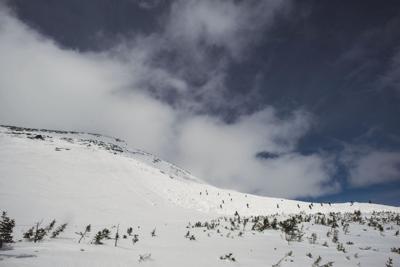
The aftermath of a huge avalanche in March 2014 on the summit cone of Mount Washington with searchers making certain no one was caught in it. Miraculously, although there were many skiers in the vicinity, not one was hurt. (JOE KLEMENTOVICH PHOTO)
The aftermath of a huge avalanche in March 2014 on the summit cone of Mount Washington with searchers making certain no one was caught in it. Miraculously, although there were many skiers in the vicinity, not one was hurt. (JOE KLEMENTOVICH PHOTO)
A snow avalanche can happen on any slope with an angle of between 25 degrees (a green-circle slope on a ski hill) and 45 degrees (a double-black diamond). All it takes is the right conditions.
An avalanche can happen any time the force exerted on the snow by gravity (or the added weight of a passing skier, hiker or climber) exceeds the forces of friction and internal bonds between snow crystals that hold the snow in place.
Keep it Clean. Please avoid obscene, vulgar, lewd,
racist or sexually-oriented language. PLEASE TURN OFF YOUR CAPS LOCK. Don't Threaten. Threats of harming another
person will not be tolerated. Be Truthful. Don't knowingly lie about anyone
or anything. Be Nice. No racism, sexism or any sort of -ism
that is degrading to another person. Be Proactive. Use the 'Report' link on
each comment to let us know of abusive posts. Share with Us. We'd love to hear eyewitness
accounts, the history behind an article.







(0) comments
Welcome to the discussion.
Log In
Keep it Clean. Please avoid obscene, vulgar, lewd, racist or sexually-oriented language.
PLEASE TURN OFF YOUR CAPS LOCK.
Don't Threaten. Threats of harming another person will not be tolerated.
Be Truthful. Don't knowingly lie about anyone or anything.
Be Nice. No racism, sexism or any sort of -ism that is degrading to another person.
Be Proactive. Use the 'Report' link on each comment to let us know of abusive posts.
Share with Us. We'd love to hear eyewitness accounts, the history behind an article.