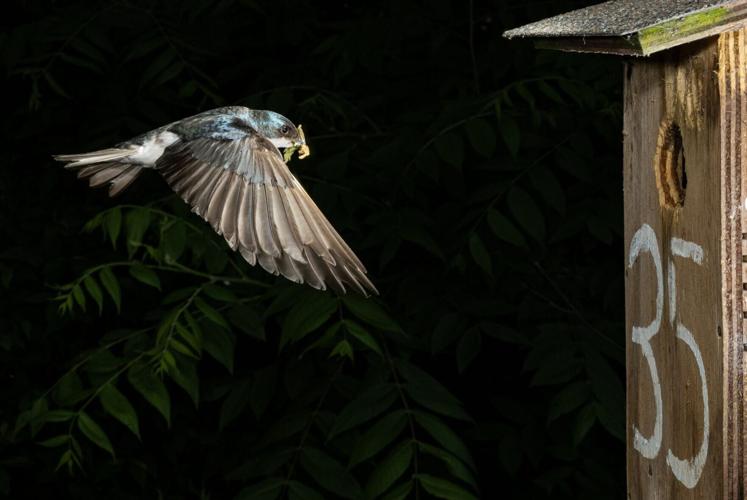
Since 1977, tree swallows at Long Point Bird Observatory have been losing mass and producing fewer offspring due to a collapse in the insect population, according to new research led by the University of Michigan. (Sherri and Brock Fenton via SWNS)
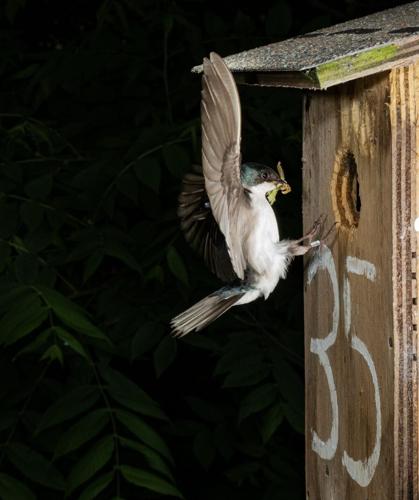
Although tree swallow populations are declining, this doesn't appear to be because of upticks in mortality, at least for the Long Point flock. (Brian Weeks via SWNS)
Long Point Bird Observatory, located in southern Ontario on a piece of land that sticks out into Lake Erie, is the oldest continuously-operated bird observatory in North America. It was founded with help from U-M alumnus David Hussel, who served as its first executive director. (Charlotte Probst via SWNS)
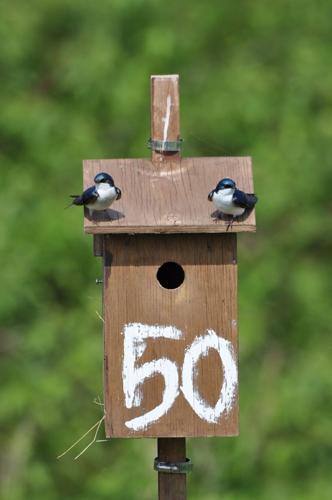
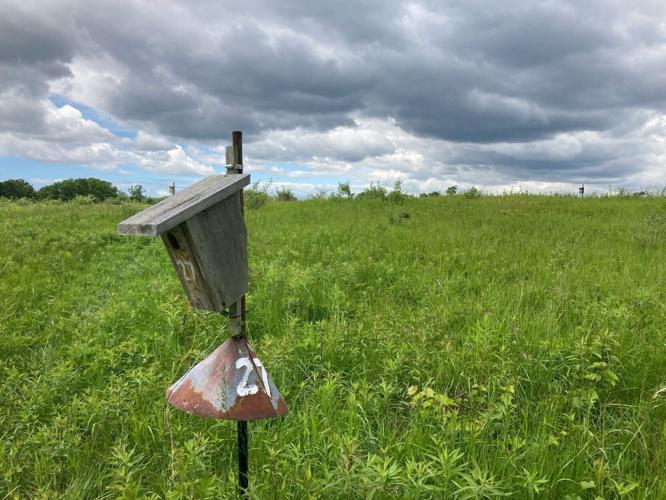
Tree swallows are uniquely suited for a study like this because they will return to nesting sites that researchers have set up for them. (Sherri and Brock Fenton via SWNS)
Since 1977, tree swallows at Long Point Bird Observatory have been losing mass and producing fewer offspring due to a collapse in the insect population, according to new research led by the University of Michigan. (Sherri and Brock Fenton via SWNS)
By Stephen Beech
Plummeting insect numbers have resulted in smaller wild birds that reproduce less, reveals new research.
Although tree swallow populations are declining, this doesn't appear to be because of upticks in mortality, at least for the Long Point flock. (Brian Weeks via SWNS)
Long Point Bird Observatory, located in southern Ontario on a piece of land that sticks out into Lake Erie, is the oldest continuously-operated bird observatory in North America. It was founded with help from U-M alumnus David Hussel, who served as its first executive director. (Charlotte Probst via SWNS)
Tree swallows are uniquely suited for a study like this because they will return to nesting sites that researchers have set up for them. (Sherri and Brock Fenton via SWNS)
Keep it Clean. Please avoid obscene, vulgar, lewd,
racist or sexually-oriented language. PLEASE TURN OFF YOUR CAPS LOCK. Don't Threaten. Threats of harming another
person will not be tolerated. Be Truthful. Don't knowingly lie about anyone
or anything. Be Nice. No racism, sexism or any sort of -ism
that is degrading to another person. Be Proactive. Use the 'Report' link on
each comment to let us know of abusive posts. Share with Us. We'd love to hear eyewitness
accounts, the history behind an article.







(0) comments
Welcome to the discussion.
Log In
Keep it Clean. Please avoid obscene, vulgar, lewd, racist or sexually-oriented language.
PLEASE TURN OFF YOUR CAPS LOCK.
Don't Threaten. Threats of harming another person will not be tolerated.
Be Truthful. Don't knowingly lie about anyone or anything.
Be Nice. No racism, sexism or any sort of -ism that is degrading to another person.
Be Proactive. Use the 'Report' link on each comment to let us know of abusive posts.
Share with Us. We'd love to hear eyewitness accounts, the history behind an article.