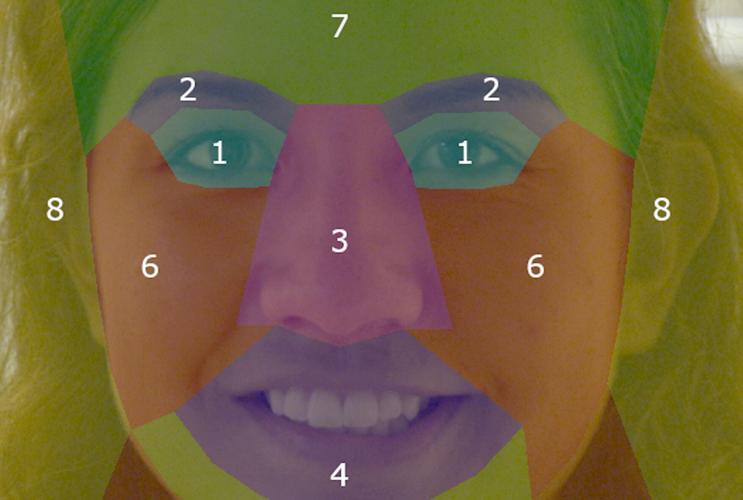
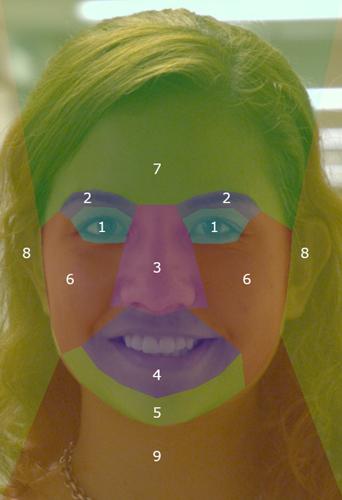
Facial feature boundaries. A face image with labeled shaded regions depicting the areas of the nine facial features defined in this study: 1. Eyes, 2. Eyebrows, 3. Nose, 4. Mouth, 5. Chin, 6. Cheeks, 7. Forehead, 8. Ears, 9. Neck. (Hahn et al2026,PLOS One,CC0 via SWNS)
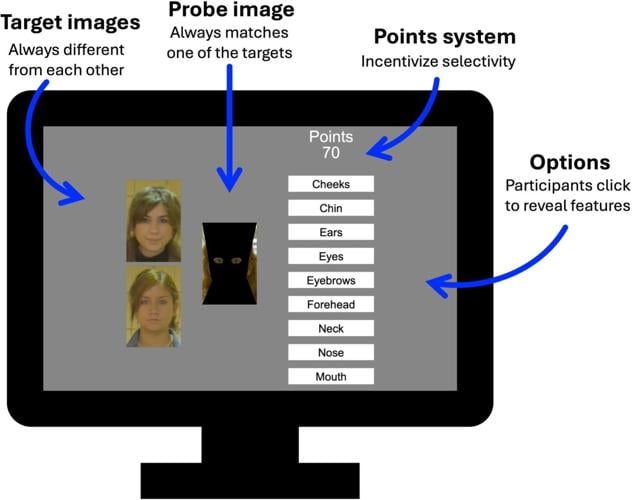
An example of an experimental trial in the self-selection condition is shown. On each trial, participants viewed two faces on the computer screen (Target images). They were always of different people. A third face began completely occluded (Probe image). Participants task was to match the identity of the probe image to one of the two target images. To make decisions, participants revealed features on the probe (Options). The example shown here corresponds to a participant selecting both Ears and Eyes. A points system was implemented to encourage selective feature reveal decisions and to discourage random guessing. Participants could keep track of their score at the top of the screen (Points system). The predetermined condition was identical except for the available feature options. Participants in that condition had only one button labeled. (Hahn et al2026,PLOS One,CC0 via SWNS)
Facial feature boundaries. A face image with labeled shaded regions depicting the areas of the nine facial features defined in this study: 1. Eyes, 2. Eyebrows, 3. Nose, 4. Mouth, 5. Chin, 6. Cheeks, 7. Forehead, 8. Ears, 9. Neck. (Hahn et al2026,PLOS One,CC0 via SWNS)
Facial feature boundaries. A face image with labeled shaded regions depicting the areas of the nine facial features defined in this study: 1. Eyes, 2. Eyebrows, 3. Nose, 4. Mouth, 5. Chin, 6. Cheeks, 7. Forehead, 8. Ears, 9. Neck. (Hahn et al2026,PLOS One,CC0 via SWNS)
By Stephen Beech
Facial identity experts can recognize someone just from their eyes or ears, reveals a new study.
An example of an experimental trial in the self-selection condition is shown. On each trial, participants viewed two faces on the computer screen (Target images). They were always of different people. A third face began completely occluded (Probe image). Participants task was to match the identity of the probe image to one of the two target images. To make decisions, participants revealed features on the probe (Options). The example shown here corresponds to a participant selecting both Ears and Eyes. A points system was implemented to encourage selective feature reveal decisions and to discourage random guessing. Participants could keep track of their score at the top of the screen (Points system). The predetermined condition was identical except for the available feature options. Participants in that condition had only one button labeled. (Hahn et al2026,PLOS One,CC0 via SWNS)
Facial feature boundaries. A face image with labeled shaded regions depicting the areas of the nine facial features defined in this study: 1. Eyes, 2. Eyebrows, 3. Nose, 4. Mouth, 5. Chin, 6. Cheeks, 7. Forehead, 8. Ears, 9. Neck. (Hahn et al2026,PLOS One,CC0 via SWNS)
Keep it Clean. Please avoid obscene, vulgar, lewd,
racist or sexually-oriented language. PLEASE TURN OFF YOUR CAPS LOCK. Don't Threaten. Threats of harming another
person will not be tolerated. Be Truthful. Don't knowingly lie about anyone
or anything. Be Nice. No racism, sexism or any sort of -ism
that is degrading to another person. Be Proactive. Use the 'Report' link on
each comment to let us know of abusive posts. Share with Us. We'd love to hear eyewitness
accounts, the history behind an article.







(0) comments
Welcome to the discussion.
Log In
Keep it Clean. Please avoid obscene, vulgar, lewd, racist or sexually-oriented language.
PLEASE TURN OFF YOUR CAPS LOCK.
Don't Threaten. Threats of harming another person will not be tolerated.
Be Truthful. Don't knowingly lie about anyone or anything.
Be Nice. No racism, sexism or any sort of -ism that is degrading to another person.
Be Proactive. Use the 'Report' link on each comment to let us know of abusive posts.
Share with Us. We'd love to hear eyewitness accounts, the history behind an article.