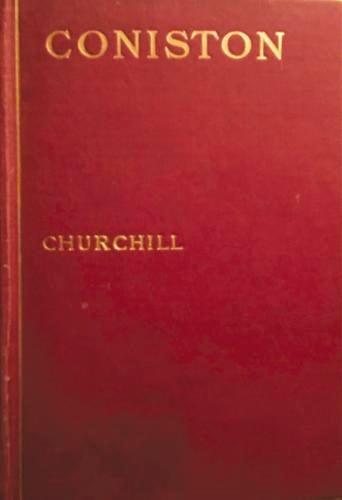
So familiar was the novelist Winston Churchill to the reading public, and so well-regarded as an engaging storyteller, that his publisher bound most of his books in the same carmine covers bearing only a title and the author's last name, all encompassed by a thin gold border.
So familiar was the novelist Winston Churchill to the reading public, and so well-regarded as an engaging storyteller, that his publisher bound most of his books in the same carmine covers bearing only a title and the author's last name, all encompassed by a thin gold border.
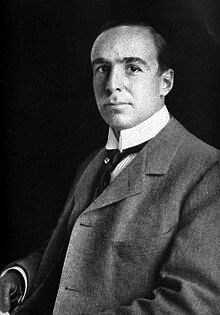
The American Winston Churchill is now largely forgotten. After a fairly privileged upbringing, he graduated from the Naval Academy at Annapolis but quickly resigned his commission, married a wealthy young heiress, and used the resulting independence to embark on a writing career. His field was historical fiction, and in 1899 he published a novel of the Revolutionary era called "Richard Carvel," which sold a couple of million copies. It fared well in England, too, prompting a presumptuous young Member of Parliament also named Winston Churchill to write, asking the novelist to consider using another name. The American declined, having preceded his correspondent on the planet by three years, so MP Churchill began distinguishing himself by including the initial of one of his middle names.
That same year of 1899, Churchill moved to New Hampshire, where artists and writers had begun gathering in several "colonies" where they could enjoy a rarefied atmosphere warmed by each other's enlightened exhalations. Churchill chose the Cornish colony, building a mansion on the northern fringe of Cornish. His close friend Maxfield Parrish, later the country's most prolific illustrator, lived a mile north of him, on the Plainfield side of the line; world-renowned sculptor Augustus St. Gaudens kept a home and studio a couple of miles south of Churchill.
Keep it Clean. Please avoid obscene, vulgar, lewd,
racist or sexually-oriented language. PLEASE TURN OFF YOUR CAPS LOCK. Don't Threaten. Threats of harming another
person will not be tolerated. Be Truthful. Don't knowingly lie about anyone
or anything. Be Nice. No racism, sexism or any sort of -ism
that is degrading to another person. Be Proactive. Use the 'Report' link on
each comment to let us know of abusive posts. Share with Us. We'd love to hear eyewitness
accounts, the history behind an article.







(0) comments
Welcome to the discussion.
Log In
Keep it Clean. Please avoid obscene, vulgar, lewd, racist or sexually-oriented language.
PLEASE TURN OFF YOUR CAPS LOCK.
Don't Threaten. Threats of harming another person will not be tolerated.
Be Truthful. Don't knowingly lie about anyone or anything.
Be Nice. No racism, sexism or any sort of -ism that is degrading to another person.
Be Proactive. Use the 'Report' link on each comment to let us know of abusive posts.
Share with Us. We'd love to hear eyewitness accounts, the history behind an article.