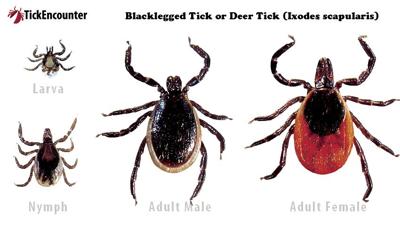
The blacklegged tick or deer tick is seen in different stages of its life cycle. Black-legged ticks often carry multiple bacteria, viruses and parasites that can be transmitted individually or along with Lyme disease bacteria. (FILE PHOTO)
The blacklegged tick or deer tick is seen in different stages of its life cycle. Black-legged ticks often carry multiple bacteria, viruses and parasites that can be transmitted individually or along with Lyme disease bacteria. (FILE PHOTO)
PORTLAND, Maine – MaineHealth is a collaborating institution with Tufts University School of Medicine on what promises to be one of the largest studies of post-treatment Lyme disease in North America.
The five-year study, funded by a $20.7 million grant from the National Institutes of Health, aims to discover the reasons why some patients fail to fully recover from Lyme disease after standard courses of antibiotics. MaineHealth will receive $3.1 million over the life of the grant for its role in the study.
Keep it Clean. Please avoid obscene, vulgar, lewd,
racist or sexually-oriented language. PLEASE TURN OFF YOUR CAPS LOCK. Don't Threaten. Threats of harming another
person will not be tolerated. Be Truthful. Don't knowingly lie about anyone
or anything. Be Nice. No racism, sexism or any sort of -ism
that is degrading to another person. Be Proactive. Use the 'Report' link on
each comment to let us know of abusive posts. Share with Us. We'd love to hear eyewitness
accounts, the history behind an article.







(0) comments
Welcome to the discussion.
Log In
Keep it Clean. Please avoid obscene, vulgar, lewd, racist or sexually-oriented language.
PLEASE TURN OFF YOUR CAPS LOCK.
Don't Threaten. Threats of harming another person will not be tolerated.
Be Truthful. Don't knowingly lie about anyone or anything.
Be Nice. No racism, sexism or any sort of -ism that is degrading to another person.
Be Proactive. Use the 'Report' link on each comment to let us know of abusive posts.
Share with Us. We'd love to hear eyewitness accounts, the history behind an article.