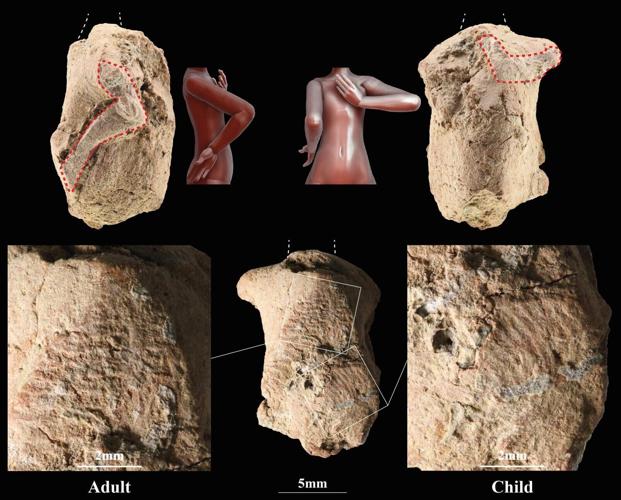
A Natufian figurine depicting a stylised human body modelled in clay 15,000 years ago, discovered at the site of Eynan-Mallaha (Upper Jordan Valley). The back of the clay figurine bears the fingerprint of an adult, covered by a child's fingerprint. This sequence of gestures in the wet clay, when the figurine was being modelled, is a rare direct testimony of inter-generational knowledge transmission in a hands-on apprenticeship. (Laurent Davin via SWNS)
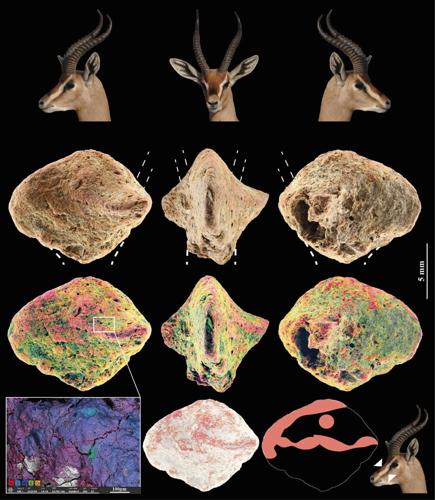
Fragment of a Natufian figurine depicting a gazelle head with horns made of perishable materials (e.g., twigs) modelled in clay 12,000 years ago, discovered at the site of Eynan-Mallaha (Upper Jordan Valley). The head was painted red with engobe (a mixture of liquid clay and ochre) to depict the gazelle's eyes and fur pattern. (Laurent Davin via SWNS)
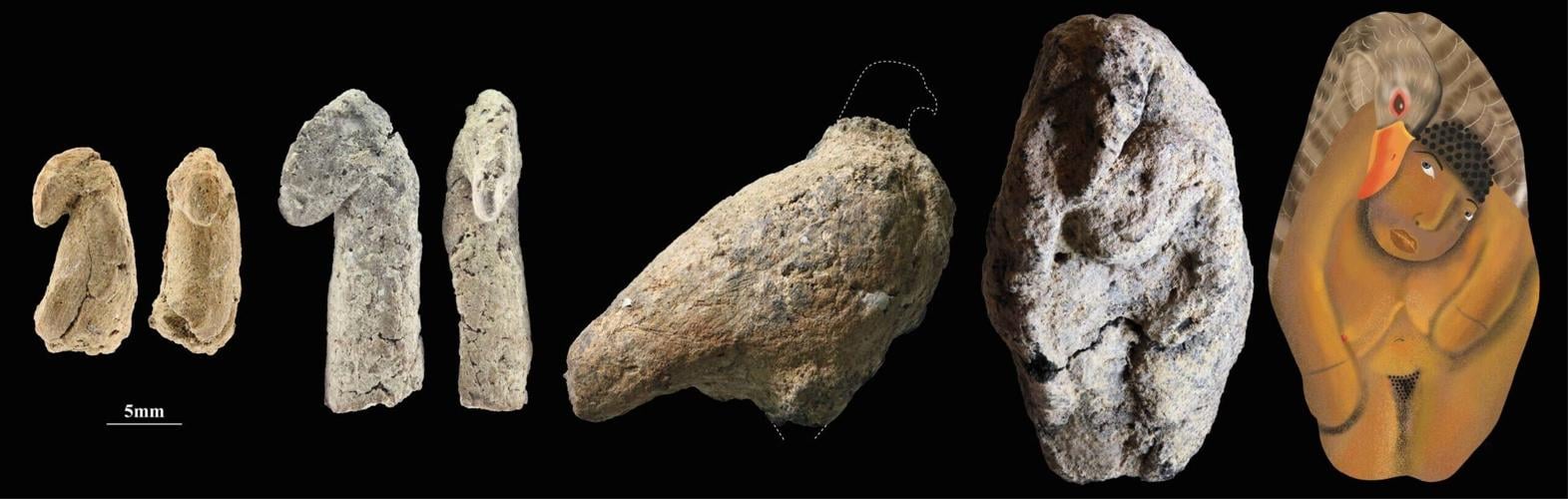
Natufian figurines depicting waterfowls, a bird of prey and a human-bird (woman-goose) interaction, modelled in clay 15,000 years ago (left) and 12,000 years ago (right), discovered at the sites of Eynan-Mallaha and Nahal Ein Gev II (Upper Jordan Valley). (Laurent Davin via SWNS)
A Natufian figurine depicting a stylised human body modelled in clay 15,000 years ago, discovered at the site of Eynan-Mallaha (Upper Jordan Valley). The back of the clay figurine bears the fingerprint of an adult, covered by a child's fingerprint. This sequence of gestures in the wet clay, when the figurine was being modelled, is a rare direct testimony of inter-generational knowledge transmission in a hands-on apprenticeship. (Laurent Davin via SWNS)
By Stephen Beech
Newly discovered clay figurines dating back up to 15,000 years show children helped shape the beginnings of artistic expression, say scientists.
Fragment of a Natufian figurine depicting a gazelle head with horns made of perishable materials (e.g., twigs) modelled in clay 12,000 years ago, discovered at the site of Eynan-Mallaha (Upper Jordan Valley). The head was painted red with engobe (a mixture of liquid clay and ochre) to depict the gazelle's eyes and fur pattern. (Laurent Davin via SWNS)
Natufian figurines depicting waterfowls, a bird of prey and a human-bird (woman-goose) interaction, modelled in clay 15,000 years ago (left) and 12,000 years ago (right), discovered at the sites of Eynan-Mallaha and Nahal Ein Gev II (Upper Jordan Valley). (Laurent Davin via SWNS)
Keep it Clean. Please avoid obscene, vulgar, lewd,
racist or sexually-oriented language. PLEASE TURN OFF YOUR CAPS LOCK. Don't Threaten. Threats of harming another
person will not be tolerated. Be Truthful. Don't knowingly lie about anyone
or anything. Be Nice. No racism, sexism or any sort of -ism
that is degrading to another person. Be Proactive. Use the 'Report' link on
each comment to let us know of abusive posts. Share with Us. We'd love to hear eyewitness
accounts, the history behind an article.







(0) comments
Welcome to the discussion.
Log In
Keep it Clean. Please avoid obscene, vulgar, lewd, racist or sexually-oriented language.
PLEASE TURN OFF YOUR CAPS LOCK.
Don't Threaten. Threats of harming another person will not be tolerated.
Be Truthful. Don't knowingly lie about anyone or anything.
Be Nice. No racism, sexism or any sort of -ism that is degrading to another person.
Be Proactive. Use the 'Report' link on each comment to let us know of abusive posts.
Share with Us. We'd love to hear eyewitness accounts, the history behind an article.