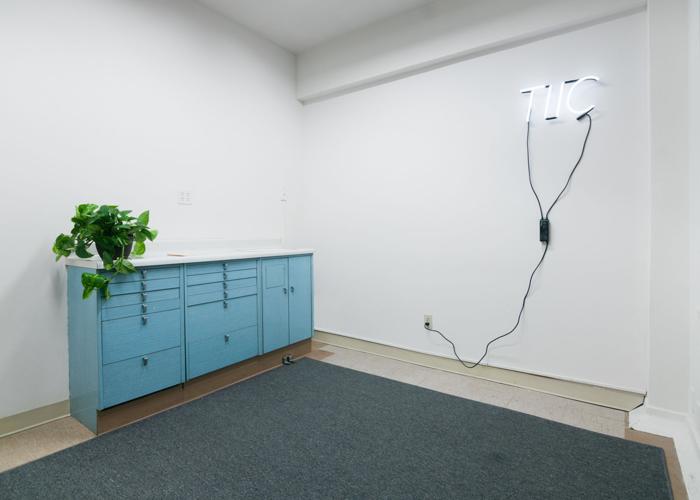
The artist Sandra Erbacher’s current practice visually explores Edwin Black’s work of investigative journalism, IBM and The Holocaust. Published in 2001, Black’s book maps out the historical partnership between IBM and the Nazi Regime, including the sale and ongoing service of Hollreith punch card technology which expedited the efficient genocide of millions of Jews and other oppressed minorities throughout Europe. Across two concurrent exhibitions in Portland — Geometry of Oppression at SPACE Gallery and TIIC at Border Patrol — Erbacher’s work grapples with how this evidence runs counter to dominant narratives in our culture, in particular the United States’ moral righteousness during the World Wars and the supposedly benign nature of IBM’s omnipresence in modern American life. The results are aesthetically complex and deconstructionist in spirit, calling into question accepted mainstream truths and tugging away at any notion of a singular history.
Down the road at SPACE, Geometry of Oppression is more illustrative in its nature, featuring a diagram of Black’s claims in a classic bureaucratic flowchart as well as several exquisite pairings of archival imagery: one half drawn from 1970s era corporate office furniture catalogues, the other from diagrammatic and architectural plans of the Third Reich. These juxtapositions vibrate with tension, containing striking formal similarities and potent associative dissonances. It’s an effective framework that embodies vital strategies of resistance and inquiry, including how to read dominant visual culture against the grain and the subversive and counter-hegemonic potential within archival storytelling.
kA 5:ClQ=ECQmk6>m%xxr Z v6@>6ECJ @7 ~AAC6DD:@?k^6>m[ :?DE2==2E:@? 3J $2?5C2 tC32496C M pE q@C56C !2EC@=[ `ca w:89 $E[ $E6 b_h Z $!prt v2==6CJ[ dbg r@?8C6DD $E M %9C@F89 |2J `ak^Am