




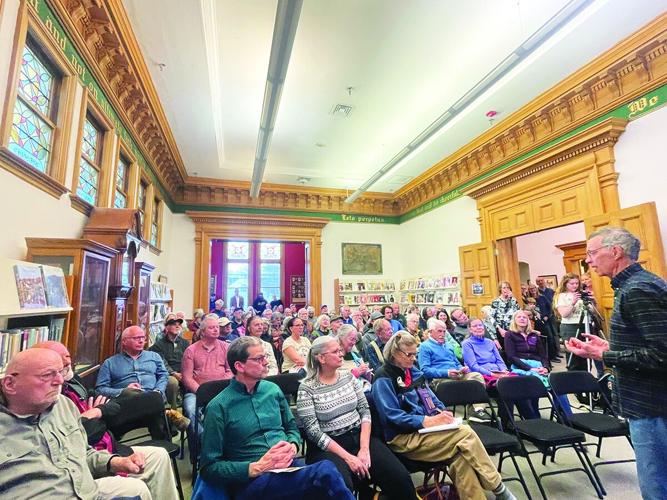
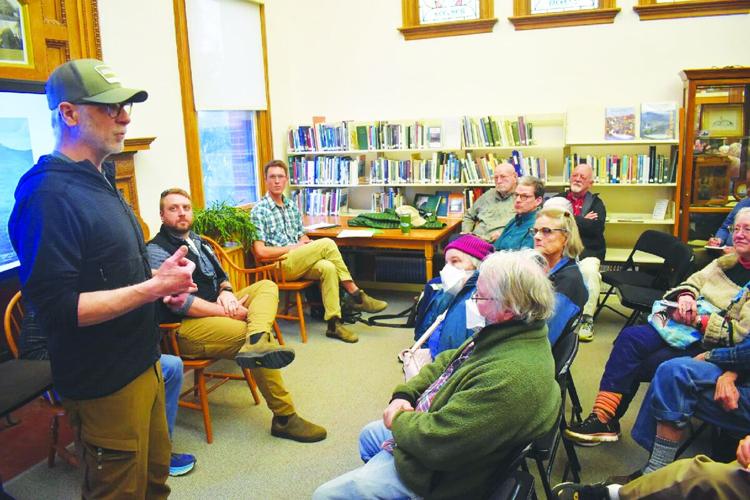

CONWAY — Just under 100 people gathered Monday at the Conway Public Library for a presentation on the future of roadless areas in the White Mountain National Forest, as advocates warned that a longstanding federal policy protecting undeveloped lands could be rescinded.
The meeting, organized by local conservation groups, focused on the federal “roadless rule,” adopted in 2001, that generally prohibits road construction and large-scale logging in designated undeveloped areas of national forests.
Speakers urged attendees to engage in the public comment process and contact elected officials as the rule faces potential rollback by the Trump administration.
“This is a bigger group than I thought it would get, so I’m very pleased with it,” organizer Jerry Curran said at the outset of the event.
Curran, a longtime Sierra Club volunteer, said the rule has been in place for 25 years and applies to areas that were roadless at the time of its adoption. “Kind of simple,” he said. “You know, anyone can do that. Just leave it as it is, because if you didn’t build a road by 2001 you probably don’t need one.”
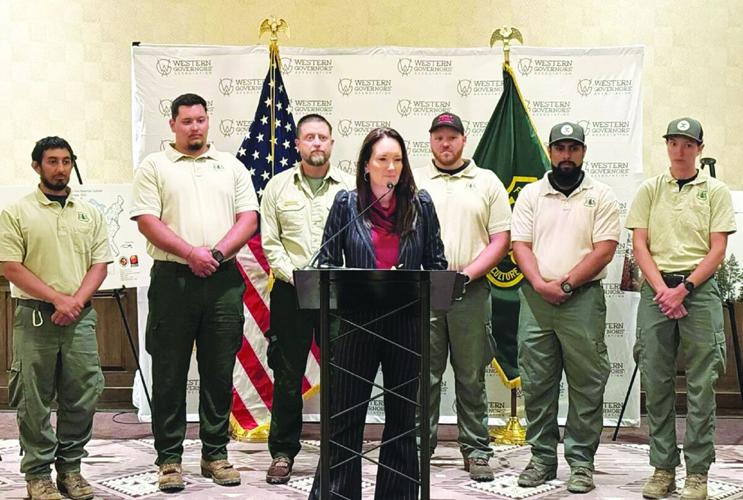
However, the U.S. Department of Agriculture, which manages the national forests begs to differ in a press release from last June.
"This outdated administrative rule contradicts the will of Congress and goes against the mandate of the USDA Forest Service to sustain the health, diversity, and productivity of the nation's forests and grasslands," said the USDA.
"Rescinding this rule will remove prohibitions on road construction, reconstruction, and timber harvest on nearly 59 million acres of the National Forest System, allowing for fire prevention and responsible timber production."
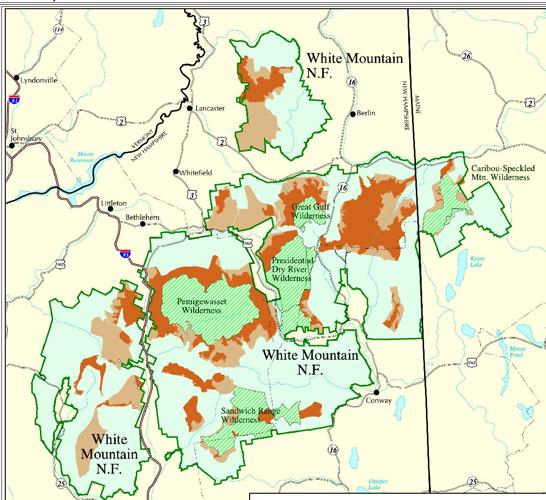
Curran said the White Mountain National Forest contains about 240,000 acres covered by the rule, describing those lands as forming a buffer around federally designated wilderness areas. Without those protections, he warned, “wildernesses become these little parks in the middle of kind of a developed area.”
The event featured several speakers, including state Rep. Anita Burroughs (D-Bartlett), who discussed a resolution she introduced in the Legislature supporting conservation of the White Mountains, but she admitted it "is not something that has teeth,” Burroughs said.
She said the measure passed the House after gaining bipartisan support, including co-sponsorship from Republican lawmakers Jonathan Smith (R-Ossipee) and Richard Brown (R-Moultonborough).
“That’s the way to get bills through, is to partner with your friends and colleagues on the other side of the aisle,” she said.
Vermont resident Chris Gish, a representative of the advocacy group Standing Trees, explained where roadless areas are located in the region, emphasizing their ecological and geographic significance.
“We’re talking about a little over a quarter of the White Mountain National Forest,” Gish said.
He described specific locations, including “the buffers that surround the Pemigewasset Wilderness on every side,” as well as “the flanks of Franconia Ridge, Mount Carrigain, the Hancocks.”
Gish also pointed to areas closer to Conway.
“If you just go just outside of town up Mount Kearsarge, you get into a roadless area,” he said, adding that the Kilkenny region in the northern part of the forest is also included.
Gish characterized roadless areas as critical “connective tissue” within the forest ecosystem, allowing wildlife habitat and natural processes to function with minimal human disturbance. He said the rule protects lands that provide clean water, climate resilience and biodiversity.
“The fact that we’re facing an accelerating ecological crisis, and one of the most common sense ... things we can do is to let intact ecosystems be,” Gish said.
But the USDA press release said, "Nearly 60 percent of forest service land in Utah is restricted from road development and is unable to be properly managed for fire risk. In Montana, it is 58 percent, and in Alaska’s Tongass National Forest, the largest in the country, 92 percent is impacted. This also hurts jobs and economic development across rural America."
Jeff Swayze, a Conway resident and licensed New Hampshire fishing and outdoor recreation guide, said the original rule "was, at the time, representative of the most extensive public input process for public lands ever assembled,” he said.
Swayze framed access to public lands as both an environmental and public health issue. “By trying to take away our access to public lands, it’s not just an issue for recreationalists, it’s not just an issue for hunters,” he said. “It’s a public health issue.”
He urged attendees to contact elected officials and remain persistent. “Direct and persistent, with the emphasis being on persistent and annoying and when needed belligerent advocacy,” Swayze said.
Speakers also highlighted economic considerations, noting the importance of outdoor recreation to the region.
Tucker Johnson of the National Parks Conservation Association said rescinding the rule could affect lands near national parks and the Appalachian Trail.
"The roadless rule protects the national forest land surrounding Pinkham Notch, Franconia Notch, and the Presidential Range from having roads constructed through them," said Johnson. "The Appalachian Trail traverses each of these special places. According to our analysis, the roadless road protects more than 775,000 acres of land within 30 miles of the Appalachian Trail."
He added that roadless protections help safeguard the visitor experience and wildlife habitat. “We’re deeply concerned that rescinding the roadless rule could lead to road construction and industrial scale logging on lands surrounding the AT,” he said.
Johnson also pointed to the economic impact of outdoor recreation in New Hampshire, citing billions in annual contributions and tens of thousands of jobs tied to the industry.
Throughout the meeting, attendees raised questions about the political and legal process surrounding the rule, including whether Congress or the president has the authority to rescind it.
Gish said that the rule is an administrative regulation rather than a law passed by Congress, meaning it can be changed through a federal rulemaking process that includes public comment. However, he said codifying similar protections into law would make them more durable.
“What the president is doing right now is within the presidential administration, trying to rescind the roadless rule,” Gish said, noting that the process still requires procedural steps under federal law.
Speakers emphasized that public participation could influence outcomes, even amid uncertainty about federal decision-making.
“We hear that last year from Senator Shaheen’s office in New Hampshire,” Gish said. “She said that public land was the top issue that her office was hearing from people about.”
Curran encouraged attendees to submit comments when the federal comment period opens and offered the option of recorded video testimony to be forwarded to the U.S. Forest Service. After the talk, 22 people lined up and spoke into a video camera at the library.
The meeting concluded with a call for continued civic engagement and advocacy.
When the Roadless Rule comment period opens, please do that," said Gish. "This is how we speak up. We shouldn't let people from on high tell us how our public lands are managed."


(0) comments
Welcome to the discussion.
Log In
Keep it Clean. Please avoid obscene, vulgar, lewd, racist or sexually-oriented language.
PLEASE TURN OFF YOUR CAPS LOCK.
Don't Threaten. Threats of harming another person will not be tolerated.
Be Truthful. Don't knowingly lie about anyone or anything.
Be Nice. No racism, sexism or any sort of -ism that is degrading to another person.
Be Proactive. Use the 'Report' link on each comment to let us know of abusive posts.
Share with Us. We'd love to hear eyewitness accounts, the history behind an article.