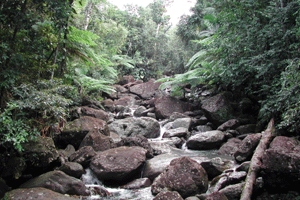
Researchers used high-frequency sensors, a new technology, at sites such as this one to assess stream chemistry at 15-minute intervals before and during Hurricane Maria. Their goal was to learn how and where solutes, such as salt, and sediment, such as sand and silt, are stored in watersheds and how these reservoirs respond to such massive storms. (COURTESY PHOTO)
Researchers used high-frequency sensors, a new technology, at sites such as this one to assess stream chemistry at 15-minute intervals before and during Hurricane Maria. Their goal was to learn how and where solutes, such as salt, and sediment, such as sand and silt, are stored in watersheds and how these reservoirs respond to such massive storms. (COURTESY PHOTO)
DURHAM — Large, extreme events such as hurricanes and superstorms are becoming more frequent under a changing climate. Researchers with the New Hampshire Agricultural Experiment Station at the University of New Hampshire are looking to new findings from a major hurricane in Puerto Rico to understand how large storms may affect New England watersheds, streams and river networks.
“New England, including New Hampshire, often receive significant precipitation due to hurricanes that travel up the Eastern seaboard. While the region’s terrain and vegetation are different compared with Puerto Rico, these results give researchers an initial predictive framework to understand local watersheds,” said Adam Wymore, research assistant professor of natural resources and the environment.
Keep it Clean. Please avoid obscene, vulgar, lewd,
racist or sexually-oriented language. PLEASE TURN OFF YOUR CAPS LOCK. Don't Threaten. Threats of harming another
person will not be tolerated. Be Truthful. Don't knowingly lie about anyone
or anything. Be Nice. No racism, sexism or any sort of -ism
that is degrading to another person. Be Proactive. Use the 'Report' link on
each comment to let us know of abusive posts. Share with Us. We'd love to hear eyewitness
accounts, the history behind an article.








(0) comments
Welcome to the discussion.
Log In
Keep it Clean. Please avoid obscene, vulgar, lewd, racist or sexually-oriented language.
PLEASE TURN OFF YOUR CAPS LOCK.
Don't Threaten. Threats of harming another person will not be tolerated.
Be Truthful. Don't knowingly lie about anyone or anything.
Be Nice. No racism, sexism or any sort of -ism that is degrading to another person.
Be Proactive. Use the 'Report' link on each comment to let us know of abusive posts.
Share with Us. We'd love to hear eyewitness accounts, the history behind an article.