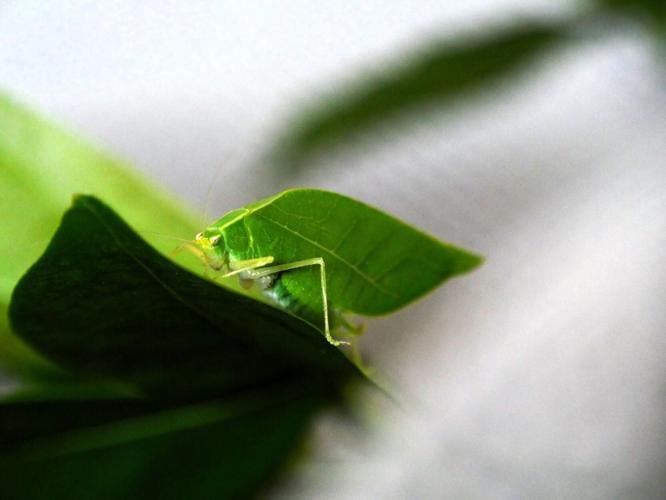
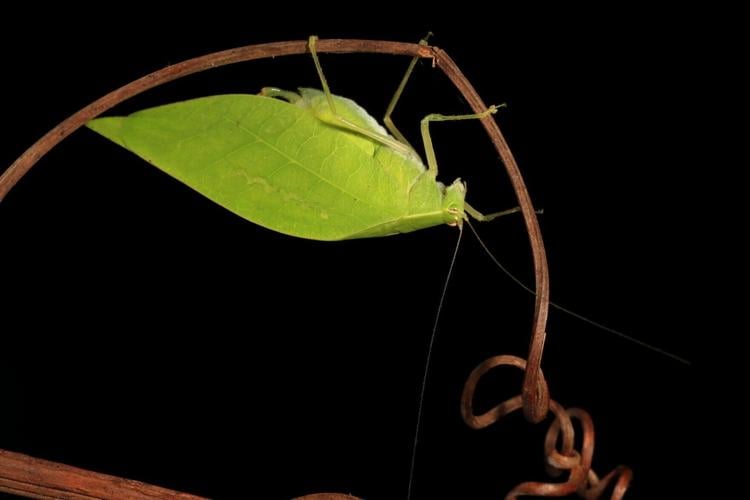
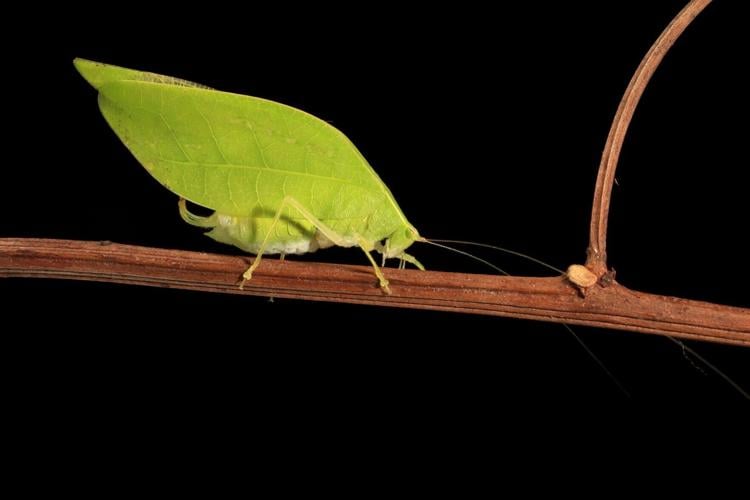
Katydids - often called long-horned grasshoppers - create songs by rubbing specialized structures on their wings together. (University of St Andrews via SWNS)
Scientists from the University of St Andrews in Scotland found out how impressive leaf mimicry can also be used to enhance the attractiveness of a sexual signal. (University of St Andrews via SWNS)
Katydids - often called long-horned grasshoppers - create songs by rubbing specialized structures on their wings together. (University of St Andrews via SWNS)
By Stephen Beech
A male insect uses its leaf mimicry to attract mates, reveals new research.
Scientists from the University of St Andrews in Scotland found out how impressive leaf mimicry can also be used to enhance the attractiveness of a sexual signal. (University of St Andrews via SWNS)
Keep it Clean. Please avoid obscene, vulgar, lewd,
racist or sexually-oriented language. PLEASE TURN OFF YOUR CAPS LOCK. Don't Threaten. Threats of harming another
person will not be tolerated. Be Truthful. Don't knowingly lie about anyone
or anything. Be Nice. No racism, sexism or any sort of -ism
that is degrading to another person. Be Proactive. Use the 'Report' link on
each comment to let us know of abusive posts. Share with Us. We'd love to hear eyewitness
accounts, the history behind an article.







(0) comments
Welcome to the discussion.
Log In
Keep it Clean. Please avoid obscene, vulgar, lewd, racist or sexually-oriented language.
PLEASE TURN OFF YOUR CAPS LOCK.
Don't Threaten. Threats of harming another person will not be tolerated.
Be Truthful. Don't knowingly lie about anyone or anything.
Be Nice. No racism, sexism or any sort of -ism that is degrading to another person.
Be Proactive. Use the 'Report' link on each comment to let us know of abusive posts.
Share with Us. We'd love to hear eyewitness accounts, the history behind an article.