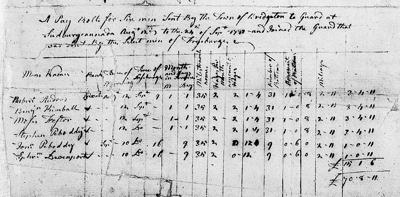
This week, it is my pleasure to introduce a small, curious, but ultimately important event in our region’s history; one which, if I dare say it, comprises our only truly local episode of the Revolutionary War. Two hundred and forty-five years ago, in early August, the entire region of western Maine was convulsed with a sudden alarm of panic, kindled on the northern frontier of what was then York County, 30 miles north of Bridgton at the new settlement of “Sudbury-Canada,” now the town of Bethel. From this town, on Aug. 3, there had come frantic runners into Fryeburg, carrying the dread news that a band of Canada Indians (properly speaking members of the St. Francis Tribe descended from Androscoggin, Pequawket, and even Mohawk refuges from New England’s earlier French and Indian wars) had lately taken to the war path, descending to fall on Bethel, Newry, Gilead, and Shelburne, N.H., in which towns they had attacked outlying farms, plundered homes, killed men, and finally caried off captives to Canada. This shocking attack, which may rightly be classed as an incident of the Revolutionary War seeing as it came from British Canada, and was led by the noted chief Tomhegan, a self-professed “Tory Indian,” greatly disturbed the young townships in this section of country; and while later history proved this raiding party consisted of only a handful of bitter warriors, folks hereabouts did not know this at the time. Rather, it was widely assumed this war party was but the vanguard of an advancing enemy army, many hundreds strong, coming down from Canada to ravage the frontier at the direction of the English, poised to open a new theatre of the Revolutionary War here in the backwoods of Maine. The threat was substantial, and we were largely unprepared for it; and this is perhaps the reason why this little incident has lived so long in local memory, celebrated to this day in our annals as the so-called, “Last Indian Raid in New England.” Now that’s not a very appropriate name for it, nor is it terribly accurate either, but seeing as I only have a limited amount of space in today’s article, I must summarize as best I can. For anyone interested in learning more about this, there will appear a companion piece to this article in the autumn issue of the Bridgton Living magazine, where I plan to really dig into the nitty-gritty details.
Keep it Clean. Please avoid obscene, vulgar, lewd,
racist or sexually-oriented language. PLEASE TURN OFF YOUR CAPS LOCK. Don't Threaten. Threats of harming another
person will not be tolerated. Be Truthful. Don't knowingly lie about anyone
or anything. Be Nice. No racism, sexism or any sort of -ism
that is degrading to another person. Be Proactive. Use the 'Report' link on
each comment to let us know of abusive posts. Share with Us. We'd love to hear eyewitness
accounts, the history behind an article.



(0) comments
Welcome to the discussion.
Log In
Keep it Clean. Please avoid obscene, vulgar, lewd, racist or sexually-oriented language.
PLEASE TURN OFF YOUR CAPS LOCK.
Don't Threaten. Threats of harming another person will not be tolerated.
Be Truthful. Don't knowingly lie about anyone or anything.
Be Nice. No racism, sexism or any sort of -ism that is degrading to another person.
Be Proactive. Use the 'Report' link on each comment to let us know of abusive posts.
Share with Us. We'd love to hear eyewitness accounts, the history behind an article.