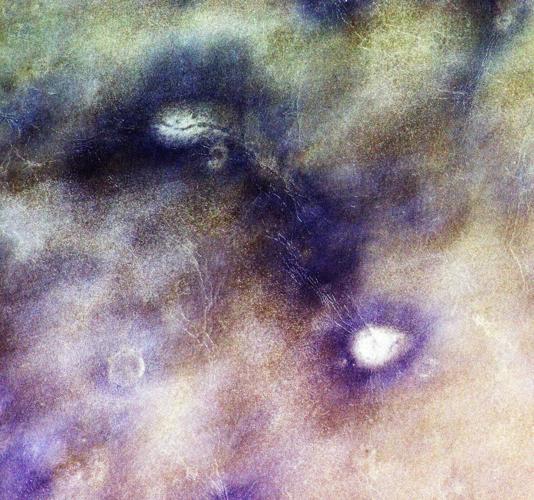
A region of Mars lying on the northern flanks of the Alba Mons volcano. The white spots may be caused by deposition around vents where magmatic gases may be escaping from Mars’s interior. The image, taken on 3 February 2023, is approximately 20 km by 20km in size and is centred at approximately 64.6°N/274.4°E. (ESA / TGO / CaSSIS via SWNS)
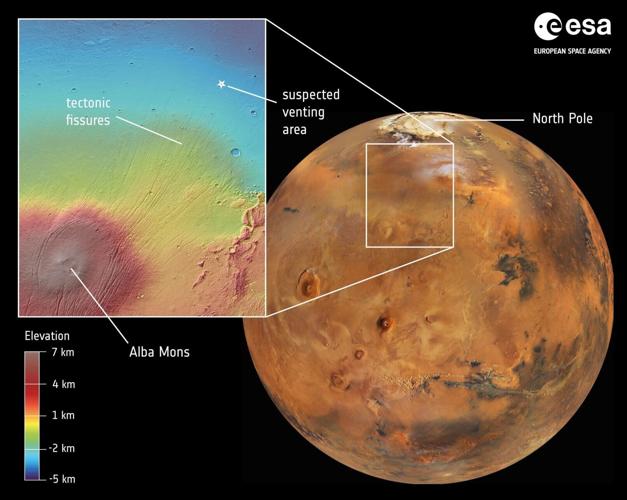
The northern flanks of the Alba Mons volcano on Mars in wider context. The white icon shows the location of the close-up image featured in this story. (EX / HRSC / ESA / DLR / FU Berlin via SWNS)
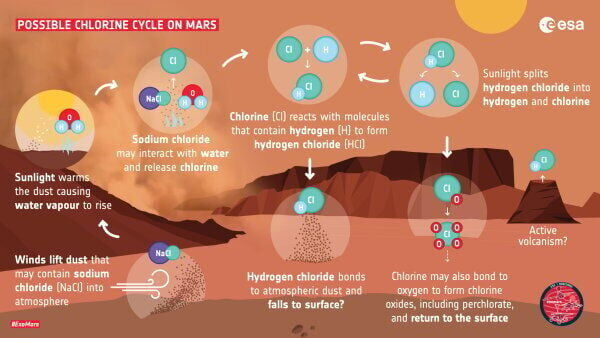
A possible new chemistry cycle on Mars following the discovery of hydrogen chloride in the atmosphere by the ESA-Roscosmos ExoMars Trace Gas Orbiter. Salts in the form of sodium chloride (NaCl) Â remnants of evaporated oceans and embedded in the dusty surface of Mars are widespread on the surface of Mars. Winds lift this salty dust into the atmosphere. Sunlight warms the dusty atmosphere causing water vapour released from ice caps to rise. The salty dust reacts with atmospheric water to release chlorine (Cl), which itself then reacts with molecules containing hydrogen (H) to create hydrogen chloride (HCl). A similar process takes place on Earth: sea salt is blown into the air, and if it mixes with water vapour, chlorine becomes available for chemical reactions that form HCl. (ESA via SWNS)Release date: November 4 2026
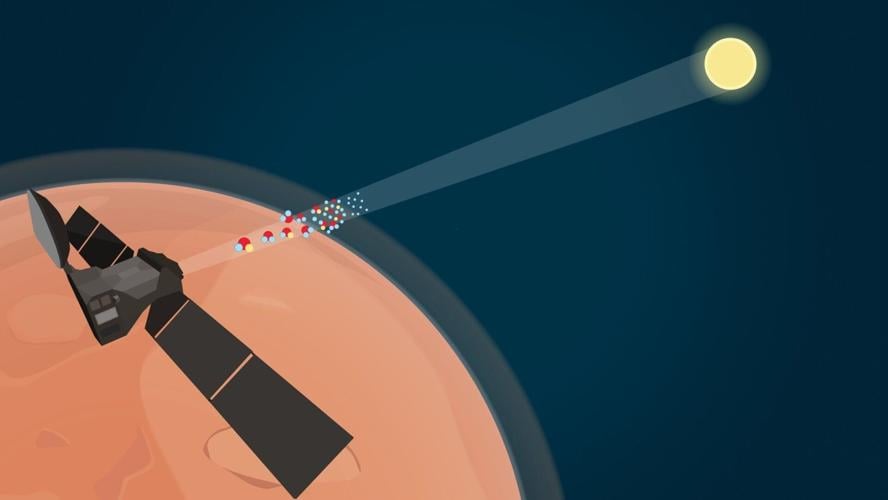
Artist impression of the ExoMars Trace Gas Orbiter (TGO) analysing the martian atmosphere. The solar occultation method is depicted: the onboard spectrometers ACS and NOMAD look at the way sunlight is absorbed in the atmosphere to reveal the chemical fingerprints of its ingredients. (ESA via SWNS)
A region of Mars lying on the northern flanks of the Alba Mons volcano. The white spots may be caused by deposition around vents where magmatic gases may be escaping from Mars’s interior. The image, taken on 3 February 2023, is approximately 20 km by 20km in size and is centred at approximately 64.6°N/274.4°E. (ESA / TGO / CaSSIS via SWNS)
By Stephen Beech
New “smoking gun” evidence of volcanic activity on Mars suggests there could be life on the red planet, say scientists.
The northern flanks of the Alba Mons volcano on Mars in wider context. The white icon shows the location of the close-up image featured in this story. (EX / HRSC / ESA / DLR / FU Berlin via SWNS)
A possible new chemistry cycle on Mars following the discovery of hydrogen chloride in the atmosphere by the ESA-Roscosmos ExoMars Trace Gas Orbiter. Salts in the form of sodium chloride (NaCl) Â remnants of evaporated oceans and embedded in the dusty surface of Mars are widespread on the surface of Mars. Winds lift this salty dust into the atmosphere. Sunlight warms the dusty atmosphere causing water vapour released from ice caps to rise. The salty dust reacts with atmospheric water to release chlorine (Cl), which itself then reacts with molecules containing hydrogen (H) to create hydrogen chloride (HCl). A similar process takes place on Earth: sea salt is blown into the air, and if it mixes with water vapour, chlorine becomes available for chemical reactions that form HCl. (ESA via SWNS)Release date: November 4 2026
Artist impression of the ExoMars Trace Gas Orbiter (TGO) analysing the martian atmosphere. The solar occultation method is depicted: the onboard spectrometers ACS and NOMAD look at the way sunlight is absorbed in the atmosphere to reveal the chemical fingerprints of its ingredients. (ESA via SWNS)
Keep it Clean. Please avoid obscene, vulgar, lewd,
racist or sexually-oriented language. PLEASE TURN OFF YOUR CAPS LOCK. Don't Threaten. Threats of harming another
person will not be tolerated. Be Truthful. Don't knowingly lie about anyone
or anything. Be Nice. No racism, sexism or any sort of -ism
that is degrading to another person. Be Proactive. Use the 'Report' link on
each comment to let us know of abusive posts. Share with Us. We'd love to hear eyewitness
accounts, the history behind an article.










(0) comments
Welcome to the discussion.
Log In
Keep it Clean. Please avoid obscene, vulgar, lewd, racist or sexually-oriented language.
PLEASE TURN OFF YOUR CAPS LOCK.
Don't Threaten. Threats of harming another person will not be tolerated.
Be Truthful. Don't knowingly lie about anyone or anything.
Be Nice. No racism, sexism or any sort of -ism that is degrading to another person.
Be Proactive. Use the 'Report' link on each comment to let us know of abusive posts.
Share with Us. We'd love to hear eyewitness accounts, the history behind an article.