




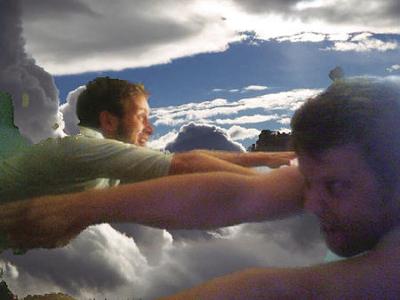
Haru Bangs have been freaking Portland out for years. Their clever combination of snotty punk, heavier than heavy sludge, and poisoned psychedelic flourish has served them remarkably well since their inception in 2007. Ever the reclusive act, the ‘Bangs have come and gone in and out of hiatus at least a few times in their eight years together as a band. But, now that the dust has settled, and now that several generations of Southern Maine bands have come and gone in their wake, Haru Bangs stand as one of Portland’s longest running and most enigmatic acts. Their recent odds n’ sods compilation (entitled simply Mix Tape #2) is proof positive of the band’s near-accidental genius, despite their best self-sabotaging intentions.
Though frontman Noah Defilippis openly admits that some of the recordings on Mix Tape go back as far as 2010, and though the record itself has been tossed off with frighteningly casual aplomb, it has all the intensity and spark of a formal full length release. From opening gutter-rock single “Surf Shitty” through the murky, mysterious closing instrumental “Teening Day,” listeners would be hard pressed to hear this as merely a collection of cutting room floor outtakes. There is a sense throughout that these tracks may not be as focused or polished as “studio” recordings are supposed to be, but that just further displays Haru Bangs’ devil-may-care attitude about nearly everything. In fact, Mix Tape reveals Haru Bangs to be one of those rare bands whose scrap material is better than the stuff most dime-a-dozen bands actually put on their official releases. “We Don’t Believe in Nothing” is an early stunner, kicking the album off at a gnarly half-tempo groove and slowly spiralling into massive waves of caustic guitar noise and warped keyboard leads. Though drummer Derek Gierhan has played with a wide variety of acts in Portland, his playing has always felt most at home within the madcap and crushing confines of Haru Bangs’ music. He’s a cymbal heavy drummer, and his playing is so kinetic and freewheeling that it recalls the early work of legendary Damned drummer Rat Scabies (see “Neat Neat Neat” but imagine it loaded on caffeine pills.) His drumming, coupled with the band’s bassy low-end scuzz, is a hallmark of the Haru Bangs sound. Atop it all, Defilippis writes alternately slashing and labyrinthine guitar parts, equal parts vintage California skatepunk and mysterious post-punk meanderings. His voice, too, is often run through a wild array of effects, at times pitched down to a terrifying sub-bass drawl and other times soaked in cavernous reverb and echo. On a track like “Machette,” rooted in standard punk and rock conventions in terms of meter and structure, the band’s absolutely wild sense of sonic exploration explodes the proceedings out of convention and into a world completely, and insanely, their own. Gierhan’s drums sound like they’re about to destroy your speakers, and Defilippis’ alternately groans, roars and chokes at the mic in his classic snarl. It’s filthy, huge, and the sheer amount of energy these dudes can put into a single recording defies easy explanation. They push noise, distortion and effects to hallucinatory levels, firmly planting them within the tradition of a long line of surrealist noise rockers. Strains of The Butthole Surfers, Scratch Acid and even Soul Discharge ‘99-era Boredoms can be heard throughout Mix Tape #2. But, in the tradition of those bands, Haru Bangs has developed a sound that’s ultimately their own. Their brand of outsider rock is shot through with a hearty dose of ’80s skatepunk; think The Big Boys, Black Flag, Gray Matter, except ground up and reassembled into a nasty hodgepodge. Perhaps the most definitive aspect of Haru Bangs’ sound is Defilippis’ twisted and now locally famous sense of humor. Throughout Mix Tape he repeats vocal lines sarcastically, bends his delivery into a maniacal sneer, and processes what might otherwise have been standard slices of heavy rock n’ roll into towering, gibberish-spewing (but still infectious) heaps of eccentric punk madness. It’s that exact sense of humor that simultaneously makes Mix Tape what it is, a seemingly tossed off collection of unreleased recordings, and allows it to transcend into a somehow terrifying and fun body of work that feels more realized than it should. If it’s any testament to the legitimacy of Haru Bangs’ craziness, or to the fact that perhaps they don’t even know how sharp their vision is, even in outtake form, the band actually asked me not to review this.


